The Impact of the Components of the Marketing Mix on the Decision to Choose the University by Iraqi Students
DOI:
https://doi.org/10.51173/tjms.v2i2.54Keywords:
Marketing mix, University choice, Higher education marketing, Student decision-makingAbstract
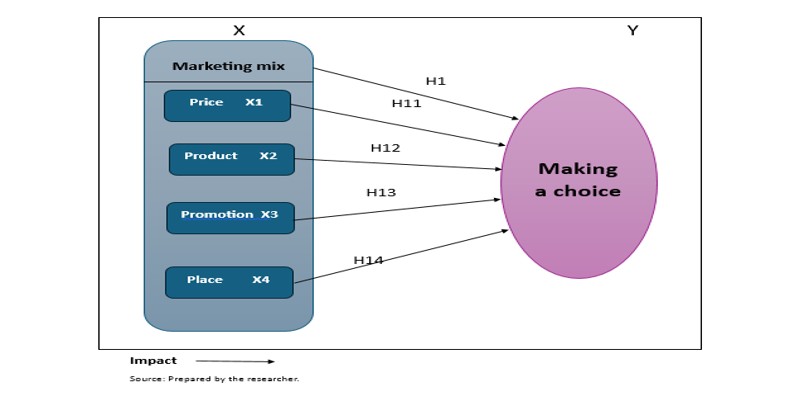
This study explores the impact of marketing mix components, product, price, place, promotion, people, process, and physical evidence on the decision-making process of Iraqi students in choosing universities, focusing on Middle Technical University. A sample of 360 students was analyzed using SPSS software through a descriptive analytical method. Results reveal a significant positive relationship between each component and students’ university choice. The study offers practical recommendations for Iraqi universities to enhance their competitiveness by aligning their marketing strategies with student needs.The goal of this research is to research the outcomes of the components of the advertising and marketing blend on the selection of universities, particularly on the Central Technical University of Iraq. A sample of 36,000 students turned into selected because the subject of research, and a representative sample of 360 college students become employed as the look at's subject. The research topic of the challenge associated with universities is to attract both domestic and international students, as universities around the world attempt to determine the concerns and preferences of potential students and utilize appropriate marketing strategies to attract them. Conversely, Iraqi universities have not devoted enough attention to this issue،The importance of this research is derived from the desperate need to enhance the technical universities' competitiveness in the field of enrollment, specifically inside the context of increasing competition from other universities. The number one studies speculation is that the components of the advertising blend have a positive impact on the students' selection to wait a college. The research is derived from a descriptive method that employs SPSS software program for records analysis. The findings of the look at imply that there is a superb and huge association among the components of the marketing blend and the decision to pick out a university. Based at the aforementioned outcomes, the look at suggests numerous tasks to presidents of universities, the maximum considerable of that's the need to choose and utilize the most effective marketing strategies that consider the students' wishes. Additionally, universities ought to use up all of their efforts and take very precise techniques with the intention to survive inside the brutal educational marketplace opposition.
References
A. M. Al-Atwi, “The Impact of Marketing Mix Elements on Students' Choice of Private Universities in the Kingdom of Saudi Arabia,” Arab J. Mark. Manag., vol. 7, no. 2, pp. 65–82, 2019.
R. Al-Farisy, S. Hassan, and N. Yusof, (2020, Jan). “Influence of marketing mix on international students’ university selection in Malaysia.” J. Educ. Learn. [Online], vol. 14, no. 1, pp. 83–92. Available: https://doi.org/10.5539/jel.v14n1p83
S. A. Mahmoud and M. A. Abdul Karim, “Analyzing the Role of the Marketing Mix in Enhancing the Competitiveness of Iraqi Public Universities,” J. Admin. Econ. - Univ. Baghdad, vol. 43, no. 126, pp. 31–49, 2021.
P. Kotler and K. F. A. Fox, Strategic Marketing for Educational Institutions, 2nd ed. Upper Saddle River, NJ: Prentice Hall, 1995.
A. Tapp, C. Hicks, and M. Stone, (2014). “The role of personal influences in students’ university choice: A comparative study of UK and international students.” J. Mark. High. Educ. [Online], vol. 24, no. 1, pp. 34–49. Available: https://doi.org/10.1080/08841241.2014.909202
C. Lovelock and J. Wirtz, Services Marketing: People, Technology, Strategy, 8th ed., pp. 138–142, 2016.
C. W. Lamb, J. F. Hair, and C. McDaniel, MKTG, 11th ed., pp. 207–208, 2018.
D. Jobber and F. Ellis-Chadwick, Principles and Practice of Marketing, 9th ed., pp. 385–386, 2019.
F. Maringe, “University and course choice: Implications for positioning, recruitment, and marketing,” Int. J. Educ. Manag., vol. 20, no. 6, pp. 466–479, 2006.
G. Armstrong and P. Kotler, Marketing: An Introduction, 14th ed., p. 497, 2020.
G. E. Belch and M. A. Belch, Advertising and Promotion: An Integrated Marketing Communications Perspective, 11th ed., pp. 149–151, 2018.
G. N. Soutar and J. P. Turner, “Students’ preferences for university: A conjoint analysis,” Int. J. Educ. Manag., vol. 16, no. 1, pp. 40–48, 2002.
L. W. Perna, “Studying college access and choice: A proposed conceptual model,” in Higher Education: Handbook of Theory and Research, vol. 21, pp. 157, 2006.
M. B. Paulsen, College Choice: Understanding Student Enrollment Behavior, pp. 56, 58, 1990.
M. H. Bazerman and D. A. Moore, Judgment in Managerial Decision Making, 8th ed., pp. 35–38, 2013.
P. Kotler and G. Armstrong, Principles of Marketing, 17th ed., pp. 278–497, 2018.
P. Kotler and K. L. Keller, Marketing Management, 15th ed., p. 423, 2016.
S. Briggs, “An exploratory study of the factors influencing undergraduate student choice: The case of higher education in Scotland,” Stud. High. Educ., vol. 31, no. 6, pp. 705–722, 2006.
S. P. Robbins and T. A. Judge, Organizational Behavior, 18th ed., pp. 198–209, 2019.