The Role of Electronic Governance in Enhancing Entrepreneurial Performance
DOI:
https://doi.org/10.51173/tjms.v2i1.23Keywords:
electronic governance, pioneering performance, Baghdad Soft Drinks Company, entrepreneurial performance.Abstract
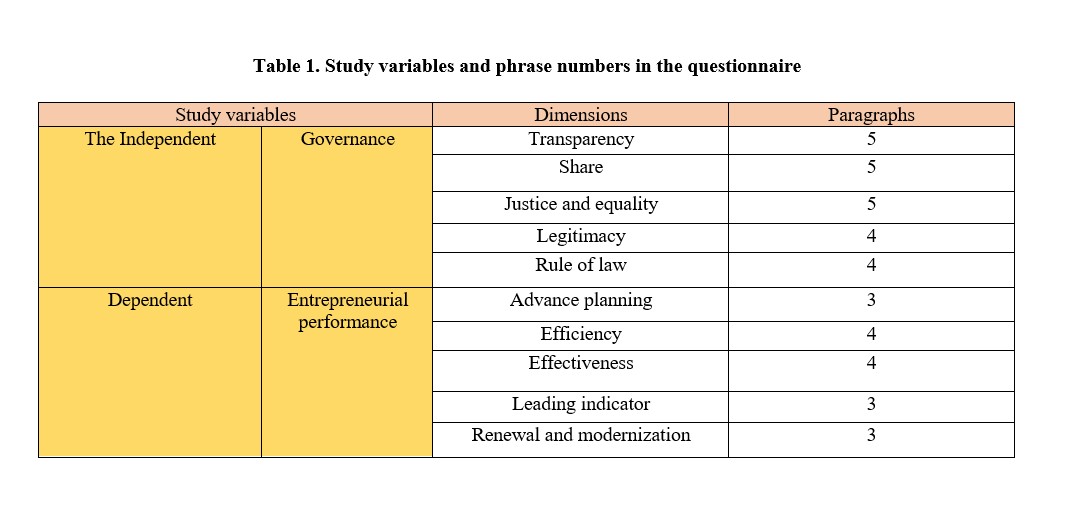
This study aims to elucidate the relationship between e-governance and company performance among a sample of board members and employees of Baghdad Soft Drinks Company in Baghdad, the descriptive approach and questionnaire were used as a study tool. consisting of 135 employees. (120) were returned for use and analysis, with a response rate of (89%). The e-governance variables include five main dimensions: transparency, accountability, participation, fairness and equity, and rule of law. The entrepreneurial performance variables include five main dimensions: planning, efficiency and effectiveness, leading indicators, innovation and modernization, and entrepreneurs. The results show that the Alpha Cro nbach coefficients of the variables included in the analysis are all higher than (0.75), and all values are between (0.788-0.980), which is a statistically acceptable value. The reliability coefficient of the variable (governance) reaches (0.983), and the reliability coefficient of the variable (development performance) reaches (0.964), indicating that the measurement tool is consistent. The results of show that the data of the study sample population follows a normal distribution because the normal distribution coefficient of entrepreneurial performance as the dependent variable totals to (1.189). It is noted from the results of that there is a significant effect between governance and entrepreneurial performance, which means that increasing governance by a standard weight of (0.733) contributes to improving entrepreneurial performance by the same amount, and this came with a constant value of (T) of (24.630) and value of (F). Its value is (606.640). The results of this study proved the validity of the hypotheses.
References
T. K. Darwish, G. Wood, S. Singh, and R. Singh, “Human resource management in India: Performance and complementarity,” European Management Review, vol. 17, no. 2, pp. 373–389, 2020. DOI: 10.1111/emre.12367.
Nazari and Q. Amirnejad, “Investigating the impact of human resources on organizational performance among the employees of Khuzestan Electricity Distribution Company,” presented at the 2nd International Conference on Management and Accounting Techniques, 2017.
M. R. Soltani and M. S. Tabar, “Investigating factors affecting the development of human resources with an institutional approach,” Human Resource Management Research, vol. 7, no. 3, pp. 51–78, 2015.
Şendoğdu, A. Kocabacak, and Ş. Güven, “The relationship between human resource management practices and organizational commitment: A field study,” Procedia – Social and Behavioral Sciences, vol. 99, pp. 818–827, 2013.
M. T. Khorand and A. Seghatoleslami, “Investigating the effect of social responsibility and emotional intelligence on entrepreneurial spirit of students at Sari Agricultural Sciences and Natural Resources University,” unpublished.
G. Al Shami and M. S. Hassan, “Evaluation of Risk Management Through the Application of the Framework (COSO) and its Reflection on Improving the Quality of Audit: A Field Study (Media and Communications Authority in Baghdad),” Journal of Techniques, vol. 5, no. 4, 2023.
M. L. Lengnick Hall, C. A. Lengnick Hall, and C. M. Rigsbee, “Strategic human resource management and supply chain orientation,” Human Resource Management Review, vol. 23, no. 4, pp. 366–377, 2013.
B. A. H. Tabatabai, H. F. Devin, H. Peymanizad, and M. Herati, “Predicting organizational agility based on organizational learning components in the General Department of Sports and Youth in South Khorasan,” presented at the 2nd National Conference on New Achievements in Physical Education and Sports, 2016.
R. D. A. Baqi, S. J. Hussein, M. M. Al Roubaie, and J. A. Alserhan, “The Effect of Social Capital on Job Performance Through the Mediating Role of the Knowledge Exchange: An Analytical Study in the Ministry of Culture, Tourism and Antiquities,” Journal of Techniques, vol. 5, no. 4, 2023.
Y. Lin, K. C. Desouza, and S. Roy, “Measuring agility of networked organizational structures via network entropy and mutual information,” Applied Mathematics and Computation, vol. 216, no. 10, pp. 2824–2836, 2010.
M. R. Ramezanian, M. Mullaei, and S. Absalan, “Organizational agility in sport and youth departments of provinces,” Sport Management Studies, no. 20, pp. 10–20, 2013.
Rostgar, S. Mazloumian, N. Ghasemi, and M. H. Saif, “Causal model of the relationship between servant leadership, psychological empowerment and organizational entrepreneurship (case study: Zahedan University of Medical Sciences),” Health Management, vol. 18, no. 61, pp. 69–81, 2015.
V. J. García Morales, M. M. Jiménez Barrionuevo, and L. Gutiérrez Gutiérrez, “Transformational leadership influence on organizational performance through organizational learning and innovation,” Journal of Business Research, vol. 65, no. 7, pp. 1040–1050, 2012.