Improving The Shopping Experience for Sports Products Using Artificial Intelligence Technologies
DOI:
https://doi.org/10.51173/tjms.v3i2.108Keywords:
Artificial intelligence; sports products; security; user experience; customer behavior analysis.Abstract
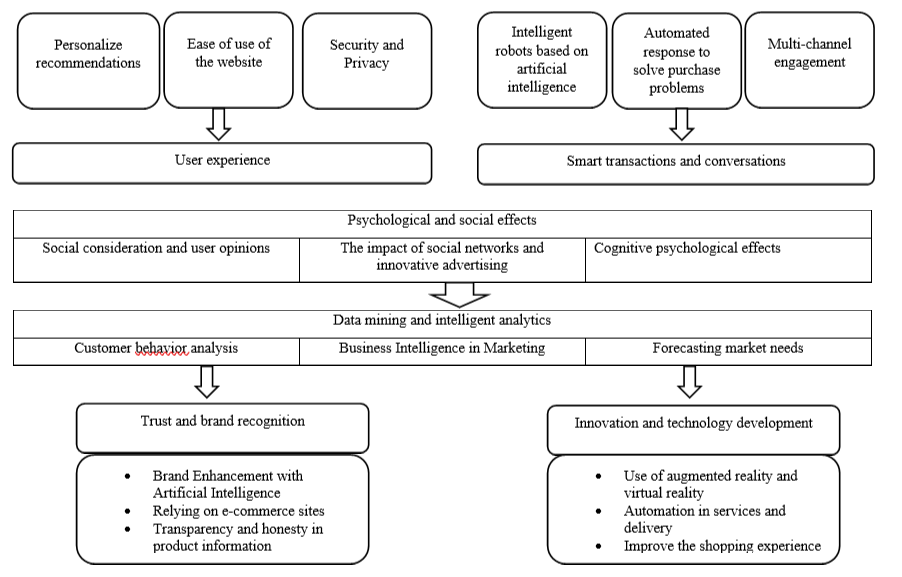
In this study, we have set out to make it easier for people in Iraq to buy sports products online. The goal was to get a sense of how artificial intelligence might make the shopping experience easier and more personal for customers. The study targeted several segments of the population — online consumers, sellers and owners of companies that produce or sell sports goods in Iraq. To find some real, useful information, we spoke to thirteen experts in-depth. These discussions were carefully organized and subsequently step-by-step analyzed to identify central themes, patterns between themes and the context in which they occurred. From the results, we found that a few things really matter when people shop online — like how easy the website is to use, how secure it feels, and how much the system seems to “know” what the customer wants. Personalized suggestions and smooth navigation make people more satisfied and more likely to buy again. We found that social media impact, a company's reputation, and trust all affect how people behave when they purchase online. Consumers who believe a brand is reliable and open about its products are more likely to purchase from it. Businesses may be able to better understand their customers and provide solutions that improve the dependable and smooth purchasing experience with the use of artificial intelligence.
References
J. Paul, A. Ueno, C. Dennis et al., “Digital transformation: A multidisciplinary perspective and future research agenda,” International Journal of Consumer Studies, vol. 48, no. 2, Art. no. e13015, 2024, doi: 10.1111/ijcs.13015.
M. Alkhaldi, “Digital transformation impact on business decision-making,” Journal of Business and Management Research, vol. 12, no. 2, pp. 45–59, 2024.
R. E. Bawack, S. F. Wamba, and K. D. A. Carillo, “Artificial intelligence in e-commerce: A bibliometric study and research agenda,” Electronic Markets, vol. 32, no. 4, pp. 1239–1262, 2022.
V. Kumar, A. R. Ashraf, and W. Nadeem, “AI-powered marketing: What, where, and how?,” International Journal of Information Management, vol. 78, Art. no. 102783, 2024.
C. Acatrinei, I. G. Apostol, L. N. Barbu, R.-G. Chivu, and M.-C. Orzan, “Artificial intelligence in digital marketing: Enhancing consumer engagement and supporting sustainable behavior through social and mobile networks,” Sustainability, vol. 17, no. 14, Art. no. 6638, 2025.
M. A. Raji, B. Olodo, T. T. Oke, W. A. Addy, and A. T. Oyewole, “E-commerce and consumer behavior: A review of AI-powered personalization and market trends,” GSC Advanced Research and Reviews, vol. 18, no. 3, pp. 66–77, 2024.
A. Shoib and A. Hermawan, “The impact of artificial intelligence (AI) on consumer behavior in digital marketing: A systematic literature review,” International Journal of Finance and Business Management, vol. 3, no. 3, pp. 161–176, 2025.
A. R. Guerra-Tamez et al., “Decoding Gen Z: AI’s influence on brand trust and purchasing behavior,” Sustainability, 2024.
F. Omeish, “Investigating the impact of AI on improving customer experience in social media marketing,” 2024.
X. Gong and M. Janssen, “The effect of transparency on trust in digital platforms: The role of perceived value and risk,” Government Information Quarterly, vol. 39, no. 4, Art. no. 101734, 2022.
M. de Carvalho, P. Chimenti, and R. dos Santos, “Human-centered artificial intelligence in digital marketing: The role of empathy, trust, and personalization,” Journal of Retailing and Consumer Services, vol. 73, Art. no. 103490, 2023.
H. L. Vemula, S. Khatri, G. Vijayalakshmi, S. Hatole, and A. K. Gubbala, “Artificial intelligence in consumer decision-making: A review of AI-driven personalization and its managerial implications,” Journal of Informatics Education and Research, vol. 5, no. 2, 2025.
A. Gungunawat, N. Khandelwal, and N. Gupta, “AI-powered personalization in digital marketing: Transforming consumer engagement and strategy,” Research Review International Journal of Multidisciplinary, vol. 9, no. 11, pp. 183–191, 2024.
Tompo, “Analysis of the use of AI technology in personalizing the consumer experience in digital marketing: A review from perspective,” Journal of Entrepreneur, Business and Management, vol. 2, no. 3, 2024.
N. Hassan, M. Abdelraouf, and D. El-Shihy, “The moderating role of personalized recommendations in the trust–satisfaction–loyalty relationship: An empirical study of AI-driven e-commerce,” Future Business Journal, vol. 11, Art. no. 66, 2025.
A. M. Kaplan and M. Haenlein, “Siri, Siri, in my hand: Who’s the fairest in the land? On the interpretations, illustrations, and implications of artificial intelligence,” Business Horizons, vol. 62, no. 1, pp. 15–25, 2019.
G. Singh and P. Singh, “A comprehensive review of augmented reality applications in digital marketing and consumer engagement,” Journal of Digital Marketing, vol. 10, no. 1, pp. 1–15, 2025.
L. Zarantonello, B. H. Schmitt, and J. J. Brakus, “The influence of AI on customer experience: A conceptual framework,” Journal of Business Research, vol. 100, pp. 1–10, 2019.
M. Arkov and J. Toth, “Challenges in integrating AI into digital marketing strategies,” Journal of Marketing Technology, vol. 15, no. 3, pp. 45–58, 2021.
S. Ragovin and R. Patel, “Consumer acceptance of AI innovations in digital marketing: A study of user perceptions,” Journal of Consumer Marketing, vol. 38, no. 4, pp. 412–423, 2021.
B. Sanders, J. Sim, T. Kingstone, S. Baker, J. Waterfield, B. Bartlam, and C. Jinks, “Saturation in qualitative research: Exploring its conceptualization and operationalization,” Quality & Quantity, vol. 52, no. 4, pp. 1893–1907, 2018.
N. Ameen, “Customer experiences in the age of artificial intelligence,” Journal of Retailing and Consumer Services, vol. 55, pp. 102–110, 2020.
A. Bakko, J. Smith, and T. Lee, “Digital travelers: The impact of artificial intelligence on online shopping behavior,” Journal of Business Research, vol. 78, pp. 102–110, 2022.
A. Nouri, R. Hassan, and S. Karim, “Factors affecting the online purchase intention among Iraqi consumers,” Journal of Retailing and Consumer Services, vol. 68, pp. 102–110, 2022.
S. H. K. Hamza and J. M. Issa, “Measuring the online shopping trends and their effects on consumer buying habits in Iraqi Kurdistan during the COVID-19 pandemic,” Qalaai Zanist Scientific Journal, vol. 8, no. 1, pp. 1176–1202, 2023.
P. Cuesta-Valiño, “The role of AI as an unconventional salesperson in online retail,” Journal of Retailing and Consumer Services, vol. 68, pp. 102–110, 2025.
A. Z. A. Shiddieqy and T. Widarmanti, “The influence of artificial intelligence in digital marketing on Generation Z consumer decision making,” Eduvest—Journal of Universal Studies, vol. 5, no. 9, pp. 10701–10718, 2025.
S. Abd-El Fattah Hammad, “The moderating effect of artificial intelligence marketing activities on the relationship between brand activism and repurchase intentions applied on e-retail stores in Egypt,” The Scientific Journal of Business and Environmental Studies, vol. 15, no. 3, pp. 1453–1506, 2024.
A. Veshesht, H. Mohammadi, and B. Zarei, “The role of AI-based recommendation systems in enhancing customer engagement and satisfaction,” Journal of Digital Marketing Studies, vol. 12, no. 3, pp. 210–230, 2025.
M. Hosseini, A. Rahimi, and A. Shafie, “Influence of social media and user reviews on online purchase decisions,” International Journal of E-Commerce Research, vol. 17, no. 4, pp. 112–130, 2021.
F. Salim, H. Bayachi, and J. Kim, “The effect of online reviews on brand trust and consumer purchasing behavior,” Journal of Internet Commerce, vol. 24, no. 2, pp. 145–167, 2025.
L. Piotro and K. Mortens, “AI in electronic payment systems: Security and transparency enhancements,” Computers in Human Behavior, vol. 35, pp. 12–23, 2014.
N. Rawah, S. Al-Mahdi, and H. Zain, “Artificial intelligence applications in e-payment systems: A review,” Journal of Financial Technology, vol. 9, no. 1, pp. 55–78, 2023.
R. Patel and R. Surur, “Observability, congruity, and AI-generated content in sports marketing,” Journal of Marketing Analytics, vol. 2, no. 3, pp. 101–115, 2014.
Y. Li and H. Liu, “Sensory online shopping experiences: AI and machine learning applications,” Electronic Commerce Research and Applications, vol. 13, no. 5, pp. 300–310, 2014.
C. Vazquez, L. Rodriguez, and M. Perez, “Evaluating consumer behavior using AI tools,” Journal of Consumer Research, vol. 40, no. 6, pp. 987–1005, 2013.
J. Cacioppo and R. Sepci, “Consumer responses to new stimuli: AI applications in marketing,” Journal of Interactive Marketing, vol. 28, no. 2, pp. 75–88, 2014.
S. Rani, “AI in virtual assistants, image and voice recognition for consumer analytics,” International Journal of AI Research, vol. 14, no. 2, pp. 55–72, 2020.
T. Hamza and R. Issa, “Online shopping adoption among youth and digital entrepreneurship trends,” Journal of Electronic Commerce in Organizations, vol. 21, no. 1, pp. 1–22, 2023.
R. Olan, J. Smith, and K. Lee, “The impact of artificial intelligence on consumer attitudes and behavior,” Journal of Consumer Research, vol. 48, no. 3, pp. 456–472, 2021.
S. Mousavi and H. Sepeli, “Artificial intelligence in consumer behavior research: Challenges and opportunities,” International Journal of Marketing Studies, vol. 14, no. 2, pp. 34–52, 2022.
R. Garkoohi, L. Ahmed, and Y. Zhou, “Development of an intelligent operating system to monitor consumer behavioral responses,” Journal of Retailing and Consumer Services, vol. 62, Art. no. 102621, 2021.